Steph, Cassy, Erin, MicaTeam Assessment
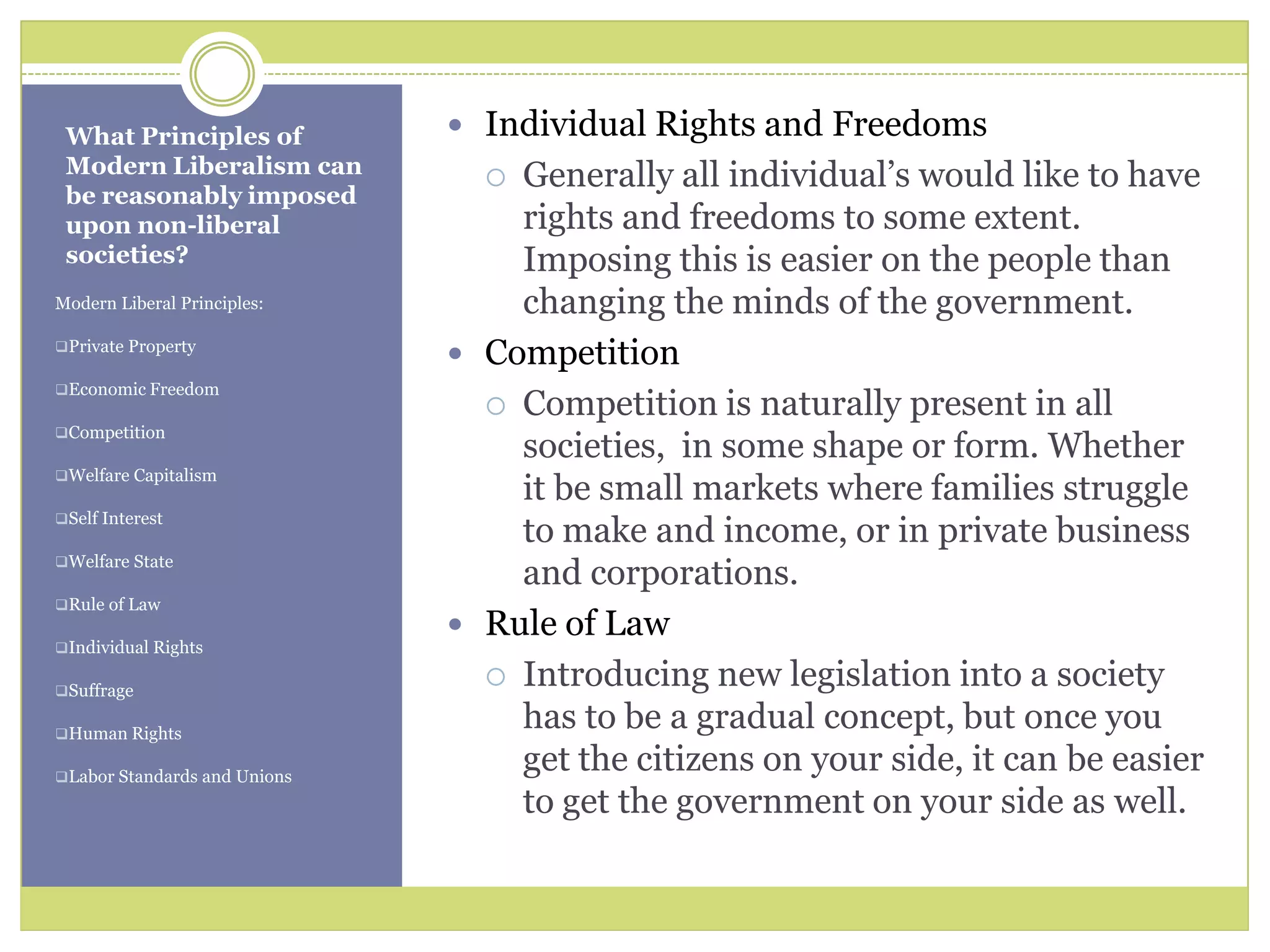
What Principles of Modern Liberalism can be reasonably imposed upon non-liberal societies?Modern Liberal Principles: Private Property
Economic Freedom
Competition
Welfare Capitalism

Team assessment erinmicastephcassy

  • 1.
    Steph, Cassy, Erin,MicaTeam Assessment
  • 2.
    What Principles ofModern Liberalism can be reasonably imposed upon non-liberal societies?Modern Liberal Principles: Private Property
  • 3.
  • 4.
  • 5.
  • 6.
  • 7.
  • 8.
  • 9.
  • 10.
  • 11.
  • 12.
    Labor Standards andUnionsIndividual Rights and FreedomsGenerally all individual’s would like to have rights and freedoms to some extent. Imposing this is easier on the people than changing the minds of the government. CompetitionCompetition is naturally present in all societies, in some shape or form. Whether it be small markets where families struggle to make and income, or in private business and corporations.Rule of LawIntroducing new legislation into a society has to be a gradual concept, but once you get the citizens on your side, it can be easier to get the government on your side as well.
  • 13.
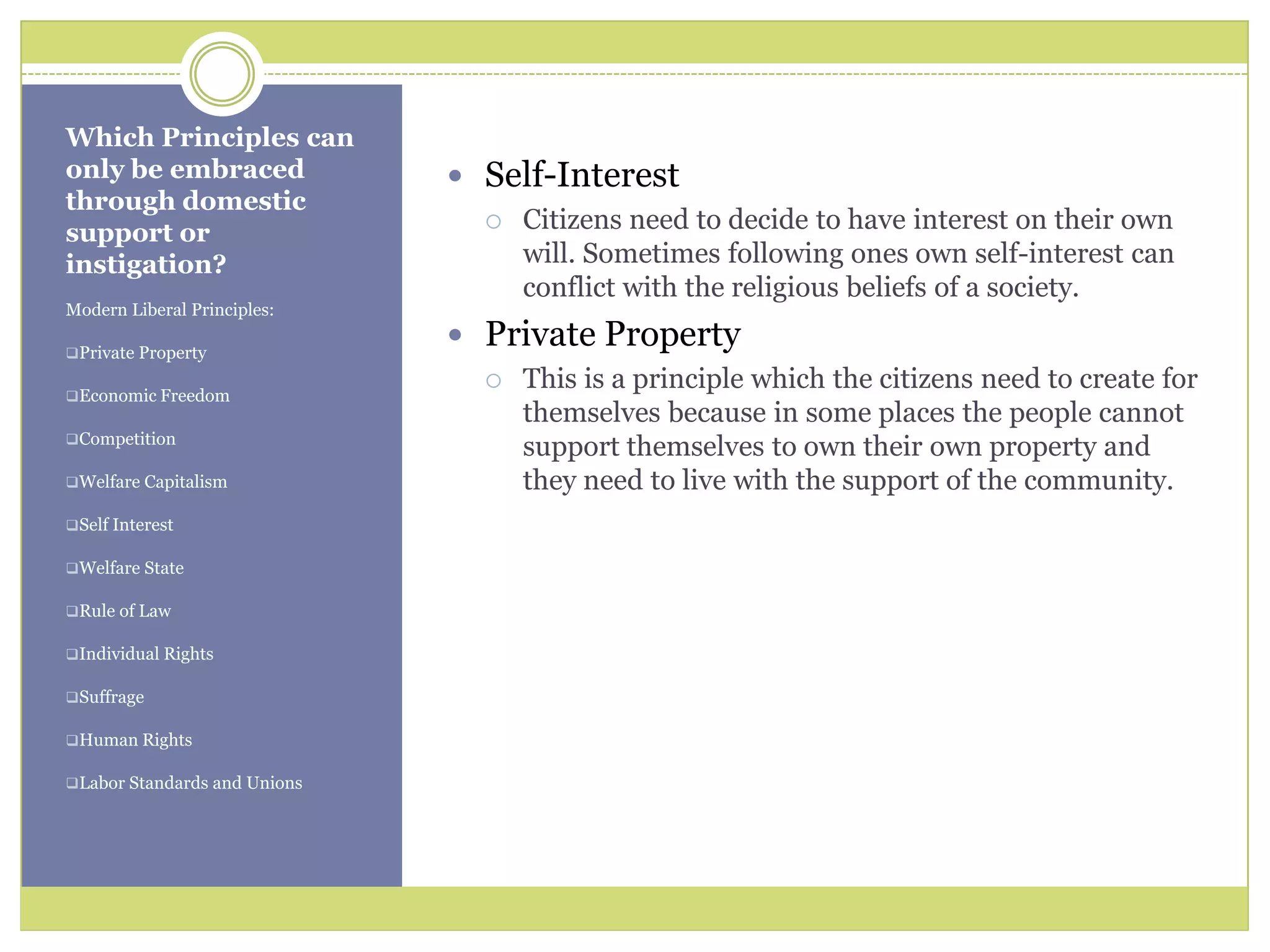
    Which Principles canonly be embraced through domestic support or instigation?Self-InterestCitizens need to decide to have interest on their own will. Sometimes following ones own self-interest can conflict with the religious beliefs of a society.Private PropertyThis is a principle which the citizens need to create for themselves because in some places the people cannot support themselves to own their own property and they need to live with the support of the community. Modern Liberal Principles: Private Property
  • 14.
  • 15.
  • 16.
  • 17.
  • 18.
  • 19.
  • 20.
  • 21.
  • 22.
  • 23.
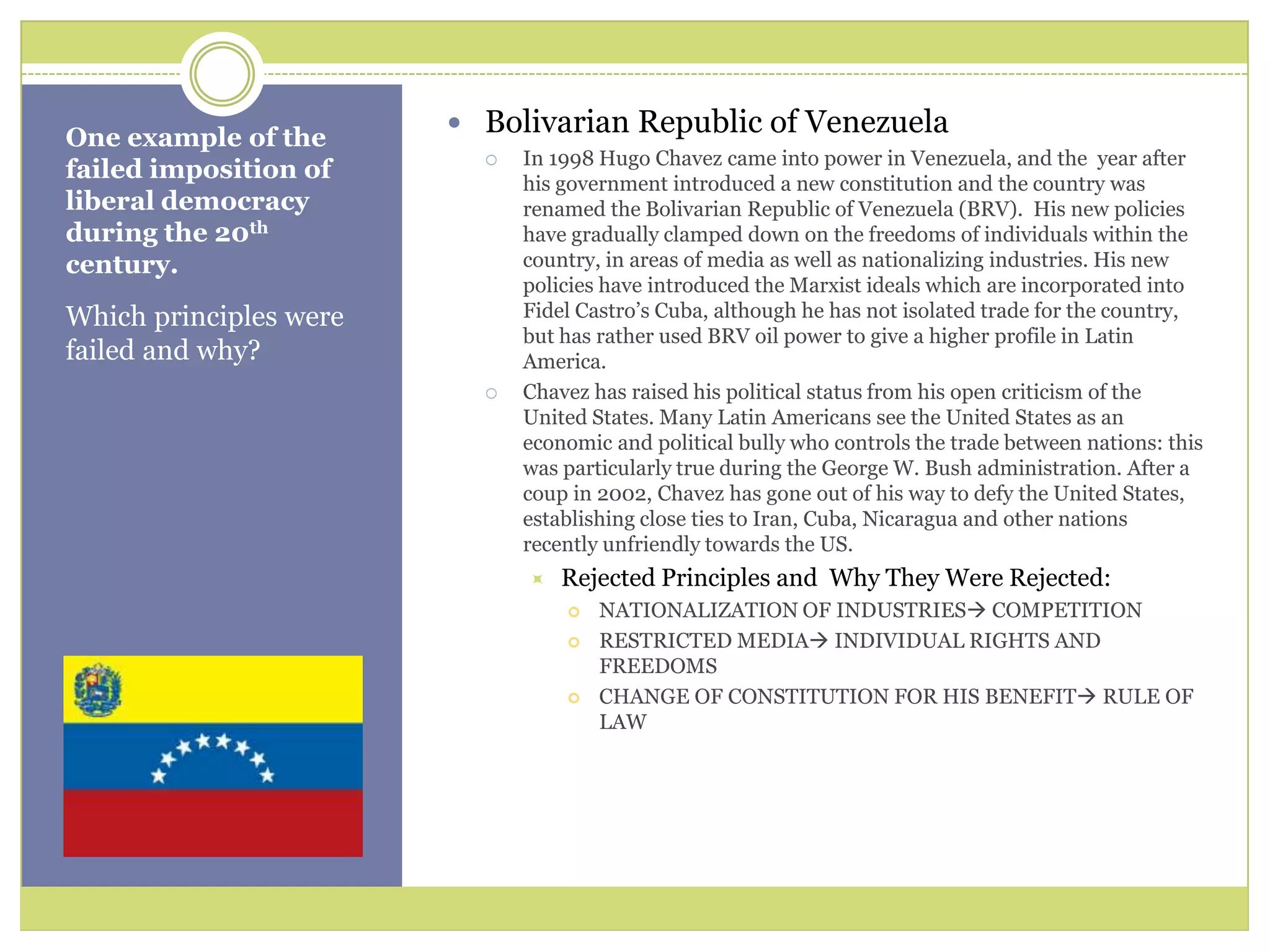
    Labor Standards andUnionsOne example of the failed imposition of liberal democracy during the 20th century.Which principles were failed and why?Bolivarian Republic of VenezuelaIn 1998 Hugo Chavez came into power in Venezuela, and the year after his government introduced a new constitution and the country was renamed the Bolivarian Republic of Venezuela (BRV). His new policies have gradually clamped down on the freedoms of individuals within the country, in areas of media as well as nationalizing industries. His new policies have introduced the Marxist ideals which are incorporated into Fidel Castro’s Cuba, although he has not isolated trade for the country, but has rather used BRV oil power to give a higher profile in Latin America.Chavez has raised his political status from his open criticism of the United States. Many Latin Americans see the United States as an economic and political bully who controls the trade between nations: this was particularly true during the George W. Bush administration. After a coup in 2002, Chavez has gone out of his way to defy the United States, establishing close ties to Iran, Cuba, Nicaragua and other nations recently unfriendly towards the US. Rejected Principles and Why They Were Rejected: NATIONALIZATION OF INDUSTRIES COMPETITION RESTRICTED MEDIA INDIVIDUAL RIGHTS AND FREEDOMSCHANGE OF CONSTITUTION FOR HIS BENEFIT RULE OF LAW
  • 24.
    CIA. (2009). CIAWorld Factbook. Retrieved May 27, 2010 from https://www.cia.gov/library/publications/the-world- factbook/index.htmlAbout.com. (2010). What does Hugo Chavez mean by a Bolivarian revolution?. Retrieved May 28, 2010 from: http://worldnews.about.com/od/venezuela/f/bolivarianrevolutio n.htmReference